
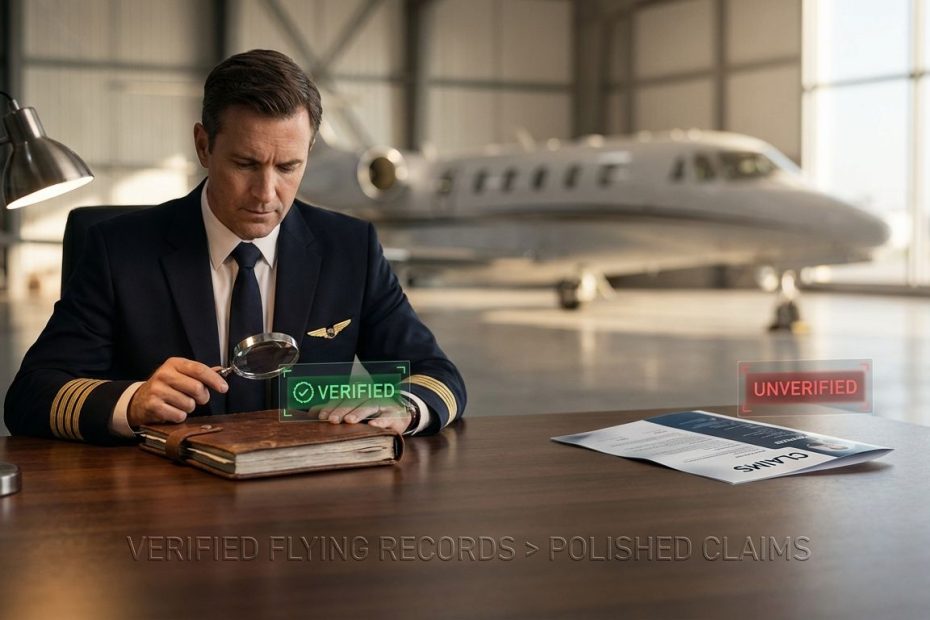
Your flight log can carry more hiring power than your resume because it does not just describe your experience, it verifies it. In av iation, your logbook is the record that supports your qualifications, your currency, your aircraft time, your endorsements, and your credibility when an employer starts checking details.
If you want better outcomes in training, interviews, and career progression, you need to treat your logbook like a primary career asset rather than a paperwork chore. This article shows why employers trust logged flight experience more than polished resume language, what hiring teams actually look for, how digital and paper records are judged, and what you need to fix before your records are tested under pressure.
Why Does A Flight Log Matter More Than A Resume In Aviation?
A resume is a summary document. It helps you organize your background, your licenses, your education, and your work history into a short narrative that is easy to scan. That matters, but it only goes so far in an industry where every major claim can be checked against actual records.
Your flight log does a different job. It shows your total time, pilot in command time, second in command time, cross-country time, instrument time, night time, aircraft type experience, recency, training events, and endorsements. When a recruiter, chief pilot, interviewer, or compliance team reviews your file, those details carry more weight than bullet points that say you are experienced, current, or ready for the next seat.
You also work in a field where legal requirements and career requirements overlap. A strong resume cannot repair missing records used to meet certificate, rating, flight review, instrument proficiency, or currency requirements. If your time is not logged accurately, you do not just have a weak application. You have a documentation problem that can affect eligibility, interview confidence, and your ability to prove what you have flown.
This is why veteran pilots talk about the logbook with a seriousness that newer applicants sometimes underestimate. The resume gets you noticed. The logbook gets you believed. When your totals are clean, organized, and defensible, your application moves with less friction and your interview answers carry more authority.
The broader career lesson is just as important. Aviation rewards proof over presentation. That is becoming true across many industries, but in flying the rule is more visible because your work is already measured in a format employers know how to audit. If you want to compete well, you need to think of your flight log as your proof file, not just your memory aid.
What Do Airlines Actually Check In Your Flight Log?
Airlines do not review your logbook just to see whether the total time number looks large enough. They look for consistency, accuracy, organization, and alignment with the rest of your application. If your resume, application, training history, employment record, and flight totals tell the same story, you remove a major source of doubt before the interview gets difficult.
That review has become more structured because hiring operators now work within a system that places more emphasis on record verification. The Federal Aviation Administration, which is the national aviation authority in the United States, established the Pilot Records Database to support review of pilot employment history, training, and qualifications. That means your application is not being considered as a standalone sales document. It is being read alongside records that can confirm or challenge what you claim.
Recruiters and interview teams also pay close attention to how your hours are categorized. Total time matters, but so do the subcategories. Multi-engine time, turbine time, pilot in command time under the right conditions, instrument time, instructor time, cross-country time, and recency in type can all affect competitiveness depending on the job. If your totals are large but your categories are messy or unsupported, your application loses force.
Presentation matters more than many pilots expect. Hiring teams often view the logbook as a professional record that should be neat, readable, signed where appropriate, and easy to reconcile. Sloppy pages, inconsistent handwriting, missing carry-forwards, unclear corrections, uncategorized digital exports, or mismatched summaries send a message that you do not manage your records with discipline.
You should also expect interviewers to probe details, not just glance at totals. They may ask how you calculated cross-country time, how you handled simulator entries, how your digital summaries were produced, or why one employer-specific total differs from a general logbook total. If you cannot explain your own system calmly and precisely, the issue stops being math and becomes trust.
Can A Flight Log Replace A Resume During Hiring?
Your flight log does not replace a resume in a formal sense, since most employers still ask for both. It often carries more decision weight once your candidacy becomes serious. The resume opens the door, but the logbook proves that you belong in the room.
This matters because aviation hiring is not built around self-description alone. A hiring team can overlook a weak phrase on a resume if your documented experience is strong and your records are clean. The reverse is harder to overcome. A polished resume cannot rescue vague or inconsistent flight-time documentation once the interviewer starts matching claims to actual entries.
That is why many experienced pilots think of the logbook as the operational version of a portfolio. In other professions, employers may want to see a body of work, a project archive, a sales record, or a technical repository. In aviation, your body of work is already captured in a format that tracks output, complexity, recency, and progression. It is one of the rare career tools that measures what you have done in terms employers can directly evaluate.
The shift matters even more now because resume writing has become easier to automate. Application language can be polished by templates, resume tools, and artificial intelligence systems in a matter of minutes. Logged flight experience does not work that way. It has to reconcile with your training path, your employment record, your endorsements, and your cumulative time. That makes the logbook more resistant to exaggeration and more valuable as proof.
If you want your application to perform at a higher level, stop treating the resume as the main event. Build the resume around the record, not the other way around. Your strongest candidate profile starts when every claim on the page can be backed by a clean trail of logged experience.
Can A Digital Logbook Really Hold Up In Interviews?
Yes, a digital logbook can hold up well in interviews if you present it as a formal record instead of an informal export. Most hiring teams care less about whether you logged electronically or on paper and more about whether your records are complete, readable, signed where needed, and easy to review without confusion.
The Federal Aviation Administration does not require one official logbook format, which gives you flexibility. You can maintain paper records, digital records, or a combination, as long as the logged time meets the applicable recordkeeping needs. That flexibility helps you build a system that fits your flying life, but it also puts the responsibility on you to preserve accuracy and produce a version that looks interview-ready.
That last part is where many applicants fall short. A digital logbook is not automatically professional just because it lives in an app. If you show up with inconsistent summaries, unsorted categories, missing endorsements, unsigned pages, or loose printouts that look rushed, you create doubt. Hiring teams do not want to decode your recordkeeping system during an interview. They want a clean document trail they can trust.
Printed and professionally organized digital exports tend to perform well because they combine the accuracy and backup benefits of electronic logging with the readability of a formal binder or book. If you maintain digital records, you should still think in terms of interview presentation. Produce polished printouts, verify page totals, include supporting endorsements, and organize tabs or indexes so a reviewer can move through the record quickly.
You should also keep your paper and digital systems synchronized if you use both. Duplicate systems only help when the numbers agree. If your paper backup says one thing and your digital summary says another, you have not created redundancy. You have created a discrepancy that someone will notice when the stakes are highest.
How Accurate Does Your Flight Log Need To Be For Hiring?
Your logbook needs to be accurate enough that your totals are internally consistent, your categories make sense, and every meaningful number can be explained without hesitation. Perfection in the mathematical sense is not always the standard hiring teams apply, but credibility is. Small arithmetic drift can happen over years of logging. Unexplained discrepancies are what damage confidence.
Many pilots discover minor differences when they convert paper totals into digital systems or rebuild old entries. Rounding practices, page-total mistakes, carry-forward errors, category interpretation, and legacy entries from training years can create small mismatches. Those issues are manageable when you identify them early, document the correction, and keep your summaries aligned across your application materials.
The larger problem appears when your records tell conflicting stories. If your airline application says one total, your interview summary says another, your digital logbook export shows a third figure, and your training history suggests something else, the issue is no longer a bookkeeping nuisance. It becomes a question about whether you understand your own experience or whether you inflated it carelessly.
You should audit your logbook before you submit a major application, not after you receive an interview invitation. Recalculate page totals, confirm carry-forwards, review category definitions, inspect aircraft type entries, reconcile simulator logging, verify endorsement copies, and compare your master totals against every application platform you use. The time you invest here protects you from embarrassment and rejection later.
Accuracy also affects how confidently you speak in the interview. A pilot who knows the record cold answers technical and experience questions with precision. A pilot who is unsure of totals starts sounding evasive even when no dishonesty exists. Your logbook is not only a compliance record. It is a confidence tool. When the numbers are right, your interview performance gets sharper.
What Happens If You Lose Your Logbook?
If you lose your logbook, you can often reconstruct much of it, but the process is slow, frustrating, and expensive in terms of time and missed momentum. You may need flight school records, rental logs, dispatch systems, instructor records, employment files, endorsements, receipts, calendar entries, aircraft scheduling tools, and older digital exports just to rebuild the basic story of your flying history.
This is one reason your logbook has more value than many pilots assign to it early in their careers. Losing a resume is inconvenient. Losing years of logged flight time can delay ratings, weaken a job application, complicate insurance requirements, slow training transitions, and force you into a reconstruction project when you should be preparing for an interview or a new assignment.
The pain increases when your recordkeeping system was casual from the start. If you relied on one paper book with no scans, no digital backup, no photos of endorsements, and no external summaries, you do not just lose convenience. You lose the easiest way to prove your history. Reconstruction becomes possible only to the extent that other records exist and can be matched with confidence.
You should treat backup discipline as part of professional record management. Scan paper pages, export digital logs regularly, save endorsement images, maintain cloud and local copies, and store records in more than one physical location. If your system depends on a single notebook, tablet, or hard drive, it is not a system. It is a vulnerability.
Strong backup habits also help in less dramatic situations. You may need to answer a training question, replace a missing endorsement image, verify an old aircraft type, or resolve a total that looks off during an application review. When your records are preserved in multiple formats, you can solve those problems in minutes instead of turning them into a week-long search.
Is Your Flight Log Basically Your Professional Portfolio?
Yes, your flight log is the closest thing aviation has to a professional portfolio. It captures your output, your progression, your operating environment, your recency, and the kinds of flying you have actually performed. A resume can summarize those points, but the logbook shows the underlying record that makes those claims credible.
This is why the comparison to a portfolio works so well beyond aviation hiring. Employers in many industries increasingly want evidence that a candidate has done the work, not just described it well. Designers show finished work. Developers show repositories and shipped products. Revenue leaders show attainment records. Pilots show logged time, endorsements, and qualifications that support what they say they can do.
Your logbook is even stronger than a typical portfolio in one important way. A portfolio often depends on curation and presentation. A flight log also depends on verification. The categories are not random, the entries are not purely subjective, and the usefulness of the record rises when the totals can be audited against training, employment, and qualification systems. That makes the aviation record unusually powerful as career proof.
You should think about this whenever you update your resume or prepare for an interview. The strongest narrative is not the most polished one. It is the one that maps cleanly to your logged history. If your resume says you are ready for more responsibility, your logbook should show the time, recency, aircraft exposure, and training path that support that step.
This mindset also improves your long-term career management. When you log accurately, categorize consistently, and preserve records carefully, you create a portable work history that travels with you from training through advanced positions. That record compounds in value. It supports not just your next interview, but every major gate in your career.
Why Is Logged Proof Becoming More Valuable Beyond Aviation?
Logged proof is becoming more valuable in many professions because claims are easier to generate than evidence. Resume polish, template language, and automated application tools make it simple for candidates to sound stronger on paper. Employers know this, which is why they increasingly reward measurable output, documented performance, and records that can be tested.
Aviation has operated this way for a long time. Hours, ratings, recency, and aircraft experience are not abstract qualities. They are recorded, categorized, and reviewed against hiring thresholds and regulatory requirements. That makes flying a useful model for where professional credibility is heading more broadly. The candidates who stand out are often the ones who can produce a clear body of work, not just a clean summary.
There is also a labor-market reason this matters. Pilot roles are tied to strong compensation and high responsibility, which means the records attached to qualification carry real financial value. When a document helps determine access to a high-income career path, interview eligibility, and training progression, it stops being administrative clutter and starts functioning as economic leverage.
You can apply that lesson directly to your own career management. Build systems that preserve proof. Keep records that show volume, consistency, quality, and progression. In aviation, that starts with the logbook. Outside aviation, the same principle appears in project records, performance dashboards, client results, technical repositories, and public work archives. The pattern is the same: evidence travels farther than description.
If you want a durable advantage, you should strengthen the record beneath the story. A better resume may improve your first impression. Better proof improves the entire hiring process. In aviation, your flight log is the clearest version of that truth.
Why Is A Flight Log More Valuable Than A Resume?
- Your resume summarizes experience, your flight log proves it.
- Airlines review logged hours, endorsements, qualifications, and consistency.
- Accurate records support hiring, currency, training, and career progression.
- Clean logbooks build trust faster than polished resume language.
Protect The Record That Builds Your Career
If you want stronger hiring outcomes in aviation, you need to treat your flight log as a core career asset, not as an afterthought. Your resume still matters, but the document that carries the deepest weight is the one that proves your time, your training, your recency, and your readiness when someone starts checking details. Clean totals, organized categories, preserved endorsements, and interview-ready presentation separate disciplined professionals from applicants who only look prepared on paper. When your logbook is accurate and defensible, your confidence improves, your application gets stronger, and your career decisions become easier to support. Protect the record, audit it before you need it, and make sure the evidence behind your career is as strong as the ambition driving it.

Chrysilios Chrysiliou is a commercial real estate executive at RDPH Properties, Inc. with a diverse background in aviation and entrepreneurship. A former Greek Air Force Academy graduate, flight instructor, and flight school co-owner, he now leverages decades of strategic leadership to identify and develop high-value real estate opportunities.