
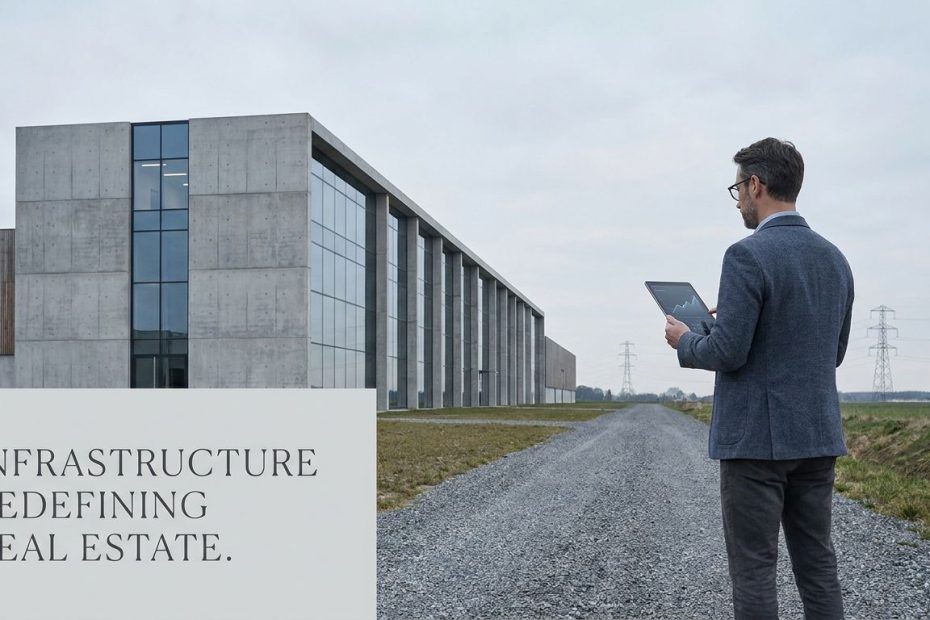
Data centers are changing real estate site selection because compute demand now makes power capacity, grid timing, fiber routes, cooling resources, and local approval more valuable than foot traffic, storefront visibility, or a nearby labor pool.
If you develop, invest in, broker, or regulate commercial property, data center real estate forces you to evaluate sites through a different lens. Artificial intelligence, cloud migration, land scarcity, incentives, and community resistance are reshaping where projects work and where they stall. This article helps you compare a promising parcel with a bankable digital infrastructure site.
The Hyperscale Gold Rush: Demand That Defies Traditional Boundaries
Hyperscale data centers are large facilities built to support cloud platforms, artificial intelligence training, enterprise workloads, and digital services that run around the clock. That demand has pushed the global data center construction pipeline to a record 38 gigawatts, according to CBRE research. In real estate terms, that is not just another industrial cycle. It is a shift in what makes land valuable.
Traditional site selection often started with people: workforce access, customer reach, highway frontage, or proximity to a central business district. A hyperscale campus starts with load. If a site can’t support the amount of electricity the operator needs, the rest of the checklist loses value. That is why sites outside historic commercial cores now compete with better-known markets.
You see this most clearly in the way hyperscale capacity is moving away from dense urban centers. McKinsey reported that nearly all new hyperscale capacity is being built outside traditional city cores. Areas once viewed as too remote for major commercial development can become competitive when they offer large parcels, utility expansion paths, and lower conflict with dense urban uses. The result is a new map of data center site selection, shaped less by foot traffic and more by energy, land, and network logic.
Power: The New Currency Of Real Estate
Power availability now drives data center site selection more than any single factor. JLL research notes that power availability has overtaken fiber connectivity as the top site selection criterion, and power-delivery timelines in primary markets can stretch three to six years. For you, that means a site with zoning in place but no near-term utility capacity may be less useful than a harder-to-entitle parcel with a clearer power path.
Data centers consume electricity at a scale most real estate asset classes never touch. A warehouse can often be evaluated by roof height, truck courts, labor access, and highway reach. A data center must be evaluated by megawatts, substation access, transmission constraints, backup systems, and the utility’s ability to deliver service on a schedule that matches capital plans. The real estate deal and the power deal now move together.
This changes the early diligence process. You can’t wait until late design to ask whether the grid can support the project. The better move is to review utility capacity, interconnection timing, upgrade costs, redundancy options, and energy procurement before you price land. In many markets, the best site is not the cheapest parcel; it is the parcel where power can arrive with the fewest delays and the least uncertainty.
Fiber And Latency: The Backbone Of Connectivity
Power may lead the decision, but fiber still shapes which sites can serve the right workloads. A data center needs strong fiber optic connectivity so users, cloud platforms, and networks can move data with low delay. Latency means the time it takes data to travel between two points, and small differences can matter for financial systems, gaming, content delivery, artificial intelligence inference, and other time-sensitive uses.
Older real estate logic often treated connectivity as a utility check. Data center real estate treats it as a core site attribute. You need to know which carriers are nearby, whether dark fiber is available, how routes connect to other markets, and how much redundancy exists if one path fails. A site with one network route may carry more operational risk than a site with multiple diverse routes.
The power-versus-fiber tradeoff is not simple. Some artificial intelligence training campuses can sit farther from population centers if they have enough electricity and strong network access. Edge facilities need to sit closer to users, devices, and applications. That split is changing demand across rural, exurban, suburban, and urban infill locations at the same time.
Tax Breaks And Regulatory Tailwinds: The Invisible Hand In Site Selection
Tax incentives can turn a second-choice market into a preferred market. Host in Ireland research found that 24 states offer data-center-specific sales tax exemptions, and those incentives are tied to market growth. For operators buying expensive servers, cooling equipment, backup systems, and electrical gear, sales tax treatment can change project economics.
You should treat incentives as part of the site’s financial profile, not as a bonus added after the real estate decision. A parcel in a market with predictable incentives, clear permitting, and utility coordination may outperform a lower-priced site with political friction. The value comes from certainty. Data center projects require large capital commitments, so delays can cost more than the land discount saves.
Municipalities also use zoning tools, overlay districts, and expedited review processes to attract or manage data centers. Those tools can help when they set clear rules for setbacks, noise, screening, power infrastructure, and water use. Poorly explained incentives create public distrust, especially when residents believe the project uses major infrastructure but creates fewer permanent jobs than other commercial uses. If you are evaluating a site, the approval climate matters as much as the written incentive package.
Land, Water, And The Environmental Equation
Land pricing now reflects the scarcity of power-ready development sites. JLL reported that land prices in top data center markets have risen 20 to 40 percent year over year. In Phoenix, land zoned for data centers has traded at roughly 1.5 million to 2 million dollars per acre, compared with about 500,000 dollars per acre several years earlier. That spread shows how quickly the market reprices land when zoning, power, and demand line up.
Large campuses need acreage for buildings, substations, backup power equipment, stormwater systems, access roads, and security buffers. That makes data centers compete with industrial parks, logistics users, energy infrastructure, and sometimes residential growth corridors. The winning parcel must solve more than size. It must support the power load, avoid major land-use conflicts, and fit the community’s infrastructure capacity.
Water has become a sharper site selection issue as cooling needs rise. Some projects rely on water for cooling, and local leaders increasingly ask whether a data center fits the area’s long-term supply plans. Loudoun County, part of Northern Virginia’s data center hub, temporarily paused approvals over water concerns. If you overlook cooling resources, water permitting, or public concern about supply, a strong land deal can turn into a stalled entitlement process.
Community Pushback Is Redrawing The Map
Community opposition now belongs in your first round of diligence. Uptime Institute research found that 70 percent of United States data center projects face some form of local opposition. Common concerns include noise, visual impact, power grid strain, water use, tax incentives, construction disruption, and the size of facilities compared with the number of permanent jobs.
Data centers can be quiet from a workforce standpoint but loud from an infrastructure standpoint. Backup generators, cooling equipment, substations, and transmission upgrades can become the focus of public meetings. Residents may support digital services in daily life and still object to a large campus near homes, schools, or rural viewsheds. That tension is now part of the real estate risk profile.
You reduce that risk by treating community engagement as a site selection input, not a public relations task after land control. Review nearby residential uses, noise standards, visual screening needs, road access, emergency response capacity, and the local history of infrastructure projects. A municipality that wants data centers may still reject the wrong site design. A skeptical community may accept a project that addresses noise, buffers, tax value, and utility planning with specific commitments.
Beyond The Campus: Where Edge Computing Takes Real Estate Next
Hyperscale campuses are only one side of the data center market. Edge computing pushes smaller facilities closer to population centers so data can be processed nearer to users and devices. STL Partners research points to demand for 100 to 200 kilowatt micro-sites in urban infill locations tied to telecom-edge needs. That creates a different real estate search than a large campus in an exurban power corridor.
Edge sites may fit into repurposed retail, office, telecom, or industrial spaces when the building has power, cooling potential, security, and network access. They do not need the same acreage as a hyperscale campus. They do need reliable operations in locations where neighbors, landlords, and city reviewers may be less familiar with data center requirements. For you, this means smaller parcels and existing buildings may gain value if they solve latency and connectivity needs.
The split between artificial intelligence training and artificial intelligence inference matters. Training can concentrate in large campuses built for dense power loads. Inference often benefits from proximity to users because applications need fast response times. Real estate site selection now has to match the workload, not just the asset label.
What This Means For Developers, Investors, And Municipalities
Developers need to underwrite utility timing with the same discipline used for land basis, construction cost, and tenant demand. A site that looks attractive on a map can fail if power upgrades take too long or local opposition blocks approvals. You should verify substations, transmission capacity, fiber routes, zoning, water needs, and noise controls before assuming the parcel is data-center-ready. The best opportunities often require early coordination with utilities and local government.
Investors need to separate durable demand from speculative land pricing. Low vacancy in primary United States data center markets, including CBRE’s reported 2.8 percent vacancy level, shows why users are chasing capacity. Secondary markets also tightened, with vacancy dropping below 5 percent for the first time in the CBRE data. That does not make every power-adjacent parcel a good investment; it means pricing must be tied to deliverable capacity, permitting probability, and operator demand.
Municipalities need to decide what type of data center growth fits their tax base, grid, water supply, and land-use goals. Clear standards can reduce conflict for residents and developers. Vague rules invite project-by-project fights that slow investment and damage trust. If a city wants digital infrastructure, it needs rules that address public costs, not just private development speed.
How To Evaluate A Data Center Site Before You Commit
A stronger diligence process starts with the utility. Ask how much power is available now, how much can be delivered later, which upgrades are needed, who pays for them, and when service can begin. Then compare that answer with the project’s planned load, phasing, backup strategy, and tenant requirements. If the timing does not align, the land price should reflect that risk.
After power, review network access, zoning, water, noise, and community fit. Fiber diversity matters because a single route can create avoidable operational risk. Zoning matters because many communities are rewriting standards for setbacks, screening, generators, and building scale. Water and cooling matter because they can trigger moratoriums, public resistance, or design changes.
You should also stress-test the political case for the project. What public benefit can local leaders explain to residents? How will the project address grid strain, sound, views, and emergency response? Are tax incentives transparent enough to withstand public review? A site that passes those questions has a stronger chance of moving from land control to construction.
Why Data Centers Change Site Selection
- Power access
- Fiber connectivity
- Low latency
- Suitable zoning and land
- Community approval
Choose Sites By Load, Not Old Habits
Data centers are changing real estate site selection by making energy, connectivity, cooling, and public acceptance the first filters for land value. You can’t evaluate these assets with the same checklist used for retail, office, or standard industrial projects. The strongest sites combine deliverable power, diverse fiber, workable zoning, cooling resources, and a realistic path through local review. The weakest sites often look cheap until utility delays, water concerns, or community resistance appear. If you remember one thing, make it this: a data center site is only as valuable as the infrastructure it can actually deliver.
Reference Links
- CBRE: Global Data Center Trends
- JLL: Data Center Outlook
- McKinsey & Company: The Data Center Boom
- datacenterHawk: Data Center Market Recap
- Uptime Institute: Annual Global Data Center Survey
- Data Center Dynamics: Data Center Development And Regulation Coverage
- Host in Ireland: United States Data Center Tax Incentive Research
- STL Partners: Edge Computing Market Sizing
- NAIOP: Data Center Development Site Selection And Construction Trends
- Bisnow: Data Center Developers Face Growing Headwinds In Site Selection

Chrysilios Chrysiliou is a commercial real estate executive at RDPH Properties, Inc. with a diverse background in aviation and entrepreneurship. A former Greek Air Force Academy graduate, flight instructor, and flight school co-owner, he now leverages decades of strategic leadership to identify and develop high-value real estate opportunities.