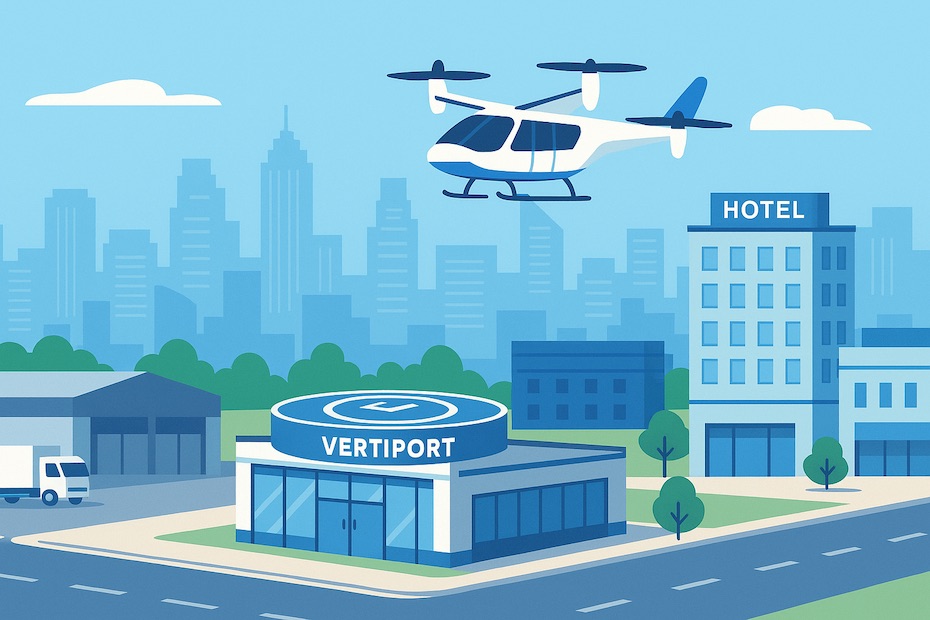
You prepare real estate planning for urban air mobility (UAM) by integrating vertiport infrastructure, securing transit-aligned sites, and designing mixed-use developments that accommodate eVTOL services and passenger flows.
This guide explains how UAM will shape your real estate decisions over the next decade. You’ll see how vertiport infrastructure changes zoning priorities, how cities are piloting integration, and what strategies can help you capture long-term value.
What is urban air mobility and how is it being implemented?
Urban air mobility uses electric vertical take-off and landing (eVTOL) aircraft for short-haul passenger and cargo transport within and between cities. These vehicles operate from purpose-built landing sites called vertiports, often located on rooftops, transit hubs, or dedicated parcels.
You’re already seeing pilot programs in major cities. Archer Aviation has committed to launching routes between New York’s JFK Airport and Manhattan, while Dubai is building a network of vertiports to connect downtown districts. This isn’t speculative—it’s moving toward operational reality.
What infrastructure does UAM require and how will it influence land use?
A functioning UAM network depends on strategically placed vertiports. Each site must have sufficient space for landing pads, charging facilities, passenger lounges, maintenance areas, and secure access control.
Real estate planning will need to accommodate these demands through zoning adjustments and integration with mixed-use developments. Large cities could require dozens of vertiports to ensure coverage, meaning that valuable rooftop space, underutilized commercial parcels, and transit-adjacent land will take on new strategic importance.
How will UAM affect property value and development opportunities?
Vertiport locations can become high-value nodes, attracting tenants that prioritize connectivity and accessibility. Properties adjacent to or integrated with vertiport facilities are likely to command rental premiums due to increased foot traffic, brand visibility, and direct access to high-speed urban transport.
This mirrors the uplift seen historically with transit-oriented developments (TODs). As UAM adoption grows, developers who secure sites near vertiports can expect enhanced occupancy stability, faster lease-up times, and broader tenant demand from sectors like hospitality, retail, logistics, and office.
Why is accessibility and multimodal integration essential for UAM success?
For a vertiport to succeed, it must connect seamlessly to ground transportation. If passengers cannot easily transfer from air to road, rail, or metro systems, the speed advantage of UAM is undermined.
Your planning should focus on multimodal integration—ensuring that vertiports have dedicated shuttle services, direct rail access, or on-site ride-share zones. This not only maximizes passenger throughput but also supports higher property valuations in surrounding areas.
What regulatory and technical requirements should you account for?
Regulations are still evolving. In the U.S., the Federal Aviation Administration (FAA) is creating new certification pathways for eVTOL aircraft and vertiport design. In Europe, EASA is advancing vertiport standards to streamline safety and operational approvals.
Technical requirements include noise management, safety buffers, charging station compatibility, and integration with air traffic control. You’ll need to factor these into planning applications and early-stage design to avoid costly delays during development.
How are cities currently piloting UAM infrastructure?
Several cities are already shaping their real estate strategies around UAM pilots. Coventry, UK, launched “Air-One,” a pop-up vertiport demonstrating passenger terminals, logistics zones, and command centers, all built in under three months.
In Brisbane, Australia, Skyports and Wagner Corporation are working toward a 30-site vertiport network in preparation for the 2032 Olympics. In California, Archer Aviation partnered with Kilroy Realty to integrate vertiport facilities into commercial real estate, positioning air mobility as a premium tenant amenity.
What can urban planning research teach you about UAM integration?
Urban planning research provides actionable models for site selection. Studies from Seoul used geographic and traffic flow data to optimize vertiport placement, ensuring coverage while minimizing congestion.
You can adapt these methods by using origin-destination data, real estate demand analytics, and environmental impact studies to identify the most profitable and feasible sites. This ensures that vertiport investments align with long-term market demand and municipal objectives.
Which real-world developments illustrate UAM’s impact on property strategy?
- Coventry’s Air-One: Proved that small parcels can host functional vertiports, catalyzing nearby commercial interest.
- Archer & Kilroy Realty, San Francisco: Integrated vertiport services into mixed-use developments, attracting high-value tenants seeking transport advantages.
- Brisbane’s Skyport Network: Demonstrates how coordinated public-private planning can align infrastructure rollout with major events, increasing both tourism and commercial real estate value.
How should real estate planning adapt to Urban Air Mobility?
- Integrate vertiports into transit hubs
- Model locations with mobility and land-use data
- Treat UAM infrastructure as a property value accelerator
In Conclusion
You position your portfolio for the next decade by treating UAM not as a distant possibility but as an imminent shift in urban transport. Integrating vertiport-ready sites into your developments, aligning with regulatory roadmaps, and designing for multimodal access will secure a competitive edge in the market. Early movers in UAM-focused real estate planning will hold the most valuable addresses in tomorrow’s urban economy.

Chrysilios Chrysiliou is a commercial real estate executive at RDPH Properties, Inc. with a diverse background in aviation and entrepreneurship. A former Greek Air Force Academy graduate, flight instructor, and flight school co-owner, he now leverages decades of strategic leadership to identify and develop high-value real estate opportunities.