
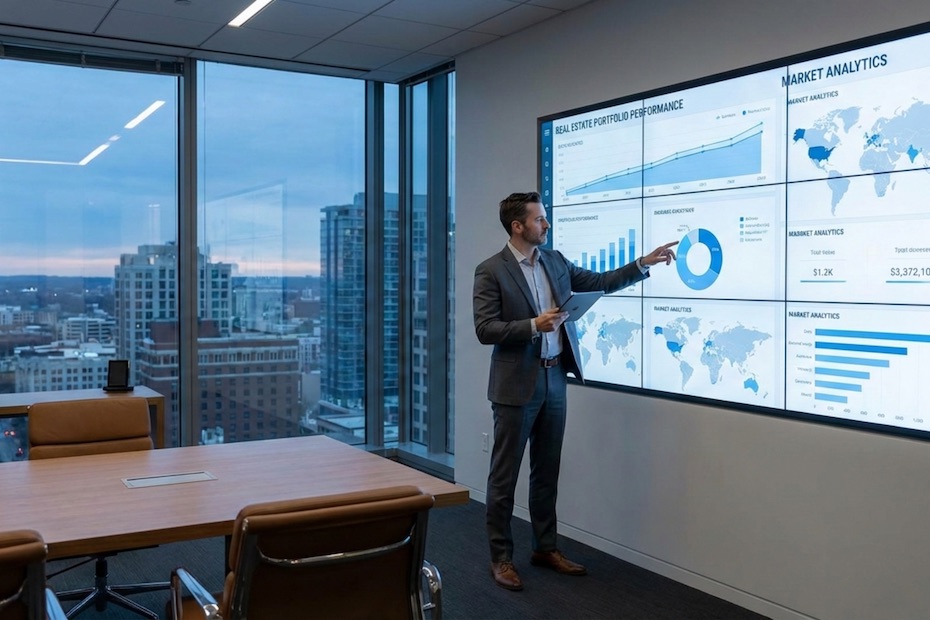
Commercial real estate in 2026 is defined by selective recovery, sharper underwriting, and assets that justify their operating cost through performance, flexibility, and data visibility. You are no longer competing on location alone; you are competing on adaptability, capital efficiency, and tenant relevance.
The value of this guide is simple. You gain a clear view of what is actually changing in commercial real estate, what is stabilizing, and where capital and operators are already repositioning for advantage.
What Is Driving the Commercial Real Estate Shift in 2026?
Commercial real estate in 2026 is shaped by capital discipline, tenant selectivity, and operational transparency rather than expansion at scale.
Transaction activity has resumed cautiously as pricing expectations align with higher financing costs. Buyers are underwriting deals with tighter assumptions, longer hold periods, and greater emphasis on income durability rather than speculative appreciation.
Tenants are behaving differently as well. Space decisions are now tied to utilization data, workforce patterns, and operating efficiency. Buildings that cannot demonstrate relevance or flexibility are being sidelined, while assets with modern systems and adaptive layouts continue to attract demand.
How Are Interest Rates and Capital Markets Affecting CRE Decisions?
Capital markets in 2026 reward patience, structure, and clarity more than speed.
Debt remains available, but lenders are selective. Loan-to-value ratios are lower, covenants are stricter, and asset quality scrutiny is higher. You are seeing more deals structured with preferred equity, mezzanine layers, or partial recapitalizations rather than traditional leverage.
Equity investors are favoring assets with predictable cash flow and repositioning potential. Core-plus and value-add strategies dominate allocation discussions, while speculative development remains limited to sectors with structural demand drivers.
Why Office Space Is No Longer a Binary Asset Class
Office real estate in 2026 is not recovering uniformly; it is fragmenting.
High-quality office assets with strong amenities, transit access, and energy efficiency continue to lease. These properties support collaboration, flexibility, and experience rather than density alone. Occupiers expect technology-enabled access control, space analytics, and adaptable floor plates.
Older office inventory faces pressure unless repositioned. Conversions to residential, mixed-use, or specialized commercial functions are becoming more common. You are seeing owners evaluate each building as a unique operating business rather than a standardized lease container.
What Asset Classes Are Gaining the Most Momentum?
Industrial and logistics properties remain among the strongest performers due to supply chain reconfiguration and e-commerce infrastructure needs.
Data centers are attracting sustained investment as digital workloads expand. These assets demand specialized power, cooling, and site selection, but they offer long-term tenant commitments and resilient demand profiles.
Retail has stabilized through experience-driven formats and service-oriented tenants. Neighborhood centers with grocery anchors and essential services outperform large format retail that lacks differentiation. Hospitality is recovering selectively, with performance tied closely to location, brand positioning, and operational control.
How Technology Is Changing Commercial Real Estate Operations
Technology in 2026 is no longer experimental within commercial real estate operations.
Owners and operators rely on integrated platforms for leasing analytics, energy monitoring, predictive maintenance, and tenant engagement. These systems reduce operating risk and support more accurate forecasting. Buildings now generate performance data that informs capital planning rather than relying on static reports.
AI-driven analytics assist underwriting, asset management, and leasing strategy. You are seeing faster decision cycles, clearer performance attribution, and more disciplined execution across portfolios.
What Tenants Expect From Commercial Buildings in 2026
Tenants in 2026 demand clarity, efficiency, and flexibility.
Lease decisions reflect total occupancy cost rather than base rent alone. Energy consumption, shared amenities, and digital infrastructure influence tenant choice. Buildings that provide visibility into usage metrics support tenant planning and retention.
Flexibility remains critical. Shorter lease terms, expansion rights, and adaptable layouts are standard negotiation points. You are seeing stronger alignment between landlords and tenants around shared operational outcomes rather than fixed arrangements.
How Sustainability Influences Investment and Leasing Decisions
Sustainability in commercial real estate now functions as a financial filter rather than a branding feature.
Energy-efficient buildings reduce operating expenses and improve underwriting assumptions. Investors favor assets that can demonstrate stable utility costs and regulatory readiness. Occupiers increasingly factor energy performance into long-term occupancy decisions.
Retrofitting existing assets with efficient systems is often more attractive than ground-up development. You gain faster returns, lower capital risk, and improved tenant positioning through targeted upgrades rather than wholesale redevelopment.
Where Capital Is Flowing in Commercial Real Estate Right Now
Capital in 2026 concentrates where performance can be measured and controlled.
Institutional investors are allocating selectively to logistics, data infrastructure, and resilient mixed-use assets. Private investors focus on smaller assets with operational upside and localized demand strength.
Geographic preferences vary, but secondary markets with strong population growth and diversified employment bases attract attention. You see less emphasis on headline cities and more focus on fundamentals that support long-term tenancy and income stability.
What Will Define Commercial Real Estate in 2026?
- Selective capital deployment
- Flexible, data-enabled buildings
- Stronger asset differentiation
- Operational performance over scale
Positioning Yourself for the Next CRE Cycle
Commercial real estate in 2026 rewards discipline, adaptability, and operational clarity. You succeed by treating each asset as a performance business rather than a static holding. Buildings that justify their cost through flexibility, efficiency, and relevance will outperform those relying on legacy assumptions. Capital will continue to favor transparency and execution over volume. If you stay focused on measurable outcomes and tenant alignment, you position yourself ahead of the next cycle rather than reacting to it.

Chrysilios Chrysiliou is a commercial real estate executive at RDPH Properties, Inc. with a diverse background in aviation and entrepreneurship. A former Greek Air Force Academy graduate, flight instructor, and flight school co-owner, he now leverages decades of strategic leadership to identify and develop high-value real estate opportunities.