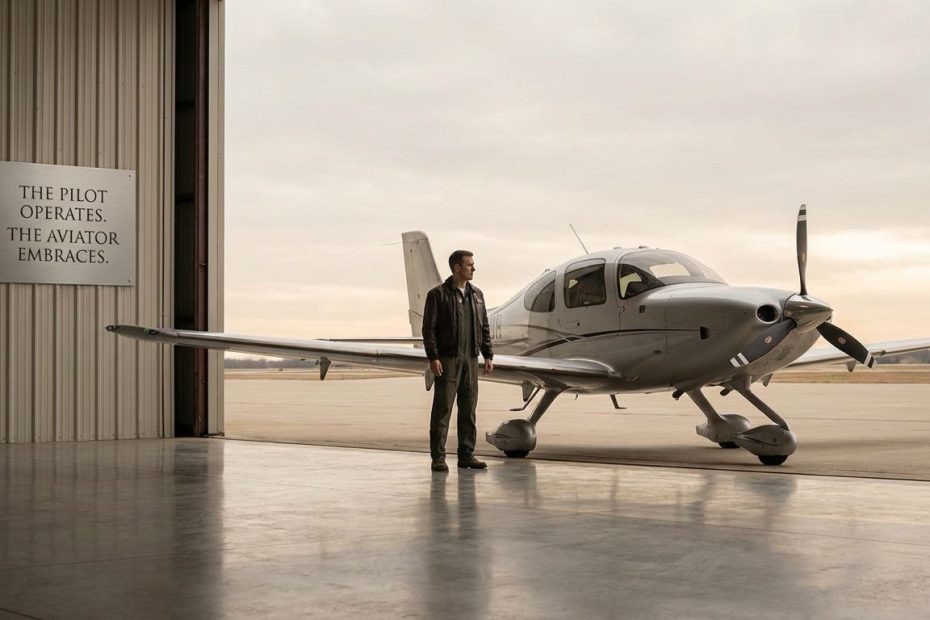
A pilot is a defined operating role tied to training, privileges, and, in civilian flying, certificates. An aviator is a broader label that often signals professional identity or military qualification, and in everyday English it’s frequently used as a synonym for pilot.
This distinction matters when you’re writing a bio, introducing yourself on the ramp, interviewing for a flying job, or trying to avoid sounding like you’re borrowing a title you didn’t earn. The sections below clarify what the terms mean in real-world usage, where the law does and doesn’t care, and how to use the language with precision.
What’s The Difference Between A Pilot And An Aviator?
In plain civilian usage, the two words overlap heavily. A standard dictionary definition treats aviator as “the operator or pilot of an aircraft,” which tells you right away that most readers will interpret “aviator” as “pilot,” with a slightly old-school tone.
The difference that keeps resurfacing in hangar talk is practical. Pilot is the term people reach for when they mean a function: who manipulates the controls, who is PIC, who is typed, who is current, who is legal to fly the flight. Aviator tends to show up when someone is pointing at a profession, a community, or a qualification track, especially in military circles.
That’s the “critical difference” worth building your article around. You can operate as a pilot on a flight without ever using “aviator” in conversation, and nobody blinks. Start calling yourself an aviator in a purely civilian setting, and you’ve just made the word do extra social work, whether you intended it or not.
Is “Aviator” Just A Fancy Word For “Pilot”?
In many settings, yes. “Aviator” reads more formal, more historical, and more stylized than “pilot,” and that’s why it shows up in brand names, squadron heritage language, and older writing about flight.
That doesn’t mean it’s wrong, it means it carries baggage. In civilian aviation, credibility is measured in currency, judgment, and consistency, not in labels. When “aviator” appears in a normal general aviation conversation, listeners often hear an attempt to sound elevated rather than specific.
Use the word intentionally. If the audience is broad, “pilot” is the cleanest and least distracting choice. If the audience is military, aerospace heritage, or aviation writing where the tone fits, “aviator” can land well, as long as it matches what you’ve actually done and earned.
Are All Pilots Aviators, And Are All Aviators Pilots?
This depends on who is doing the defining. In everyday English, plenty of people treat the terms as interchangeable. In professional environments, especially where credentials matter, the two words behave differently.
Pilot maps cleanly to regulated privileges. In the U.S., pilot certification is governed under FAA rules, and the industry uses that structure constantly: student pilot, private pilot, commercial pilot, airline transport pilot, instrument rating, category and class, type ratings, recency of experience. Those words connect to legal authority and standardized training.
Aviator doesn’t map as cleanly to a civilian regulatory checklist. It’s used as an umbrella label, a heritage term, or an identity marker. That’s why two people can argue past each other and both feel correct: one is talking about what the law and ops manual recognize, the other is talking about what the culture recognizes.
If a sentence must be legally or operationally precise, “pilot” is usually the right tool. If a sentence is about belonging to aviation as a profession, “aviator” can work, but it should stay tethered to verifiable experience.
Why Do The Navy And Marines Say “Naval Aviator” Instead Of “Pilot”?
Because in that community, “Naval Aviator” functions as an official qualification identity, not a poetic synonym. It signals that someone completed a defined training pipeline, earned the right to wear aviation insignia, and belongs to the warfare-qualified aviation community.
There’s also a practical language issue around the word “pilot” inside sea services. In maritime operations, a “pilot” can mean a harbor pilot guiding ships, so “aviator” reduces ambiguity in certain contexts. That matters when terms are used in briefings, qualifications, and formal designations.
If the article is trying to help readers avoid social mistakes, this section is where you make it concrete. In naval culture, “aviator” can be a precise title. In civilian culture, “aviator” can be interpreted as branding unless the setting supports it.
Do You Need A License To Be Called A Pilot, What Does The FAA Require?
The FAA doesn’t police casual speech, but aviation operations run on defined privileges. If you’re speaking professionally, “pilot” usually implies you’re trained and authorized to exercise pilot privileges in the relevant aircraft and operation.
For a U.S. Private Pilot certificate in many categories, the FAA’s baseline is at least 40 hours of flight time, including specific minimums for dual instruction and solo time. The FAA also points out a reality every instructor sees: even with a 40-hour minimum, the average completion time is about 75 hours for private pilot certification.
This is where “pilot” earns its weight as a word. It’s tied to logged time, training tasks, proficiency, a knowledge test, a practical test, endorsements, and ongoing currency. “Aviator” is rarely used with that kind of measurable rigor in civilian settings, so if you want your writing to sound operationally grounded, keep the core claims anchored to pilot certificates and privileges.
What’s The Deal With “Pilot Is A Technician, Aviator Is An Artist”, Is It Real?
That line circulates constantly, and the sourcing is messy. You’ll find it repeated, paraphrased, and confidently attributed, often to E.B. Jeppesen, but clean primary documentation is hard to pin down. Treat it as an aviation maxim, not as a reliably attributable quotation.
The more useful move is to explain why the quote persists. It expresses a tension pilots feel every day: aviation demands strict adherence to procedures, numbers, and standards, yet it also demands judgment, timing, and feel. People reach for a slogan to validate that both sides exist.
Use the quote carefully if you include it at all. Present it as a widely repeated saying with disputed attribution, then focus on what it reveals about how people use “aviator” as an identity label and “pilot” as an operational label. That gives readers value without overselling a shaky citation trail.
When Should You Call Yourself A Pilot Versus An Aviator?
If the setting is operational, regulatory, hiring-related, insurance-related, or training-related, “pilot” is the word that communicates cleanly. It tells people you’re talking about privileges, duties, and qualification, not just enthusiasm for aviation.
If the setting is ceremonial, historical, military, or aviation writing where identity and heritage matter, “aviator” can fit. It’s still smart to keep it honest and specific. Mention aircraft categories, roles, timeframes, or service qualification rather than leaning on a single broad label.
A simple rule keeps you out of trouble: use “pilot” when precision matters, use “aviator” only when the community you’re speaking to recognizes it as a normal term and your background supports it. That approach protects credibility and keeps the focus on substance.
What’s the Difference Between a Pilot and an Aviator?
- Pilot refers to a certified, regulated operating role with legal flying privileges
- Aviator is a broader identity term, often military or heritage-based
- In civilian use, “aviator” often sounds stylized, while “pilot” signals precision
- Use “pilot” when qualifications, legality, or operations matter
Use The Right Title, And Let Your Flying Do The Talking
“Pilot” earns trust through training standards, legal privileges, and consistent performance. “Aviator” can be a valid term, especially in military communities and aviation heritage writing, but it carries extra meaning that shifts with the audience. If you want your language to sound sharp, choose the word that matches the job you’re describing and the culture you’re speaking to. Keep the emphasis on qualifications, currency, and judgment, and the label becomes secondary. Precision in language signals precision in the cockpit.

Chrysilios Chrysiliou is a commercial real estate executive at RDPH Properties, Inc. with a diverse background in aviation and entrepreneurship. A former Greek Air Force Academy graduate, flight instructor, and flight school co-owner, he now leverages decades of strategic leadership to identify and develop high-value real estate opportunities.