
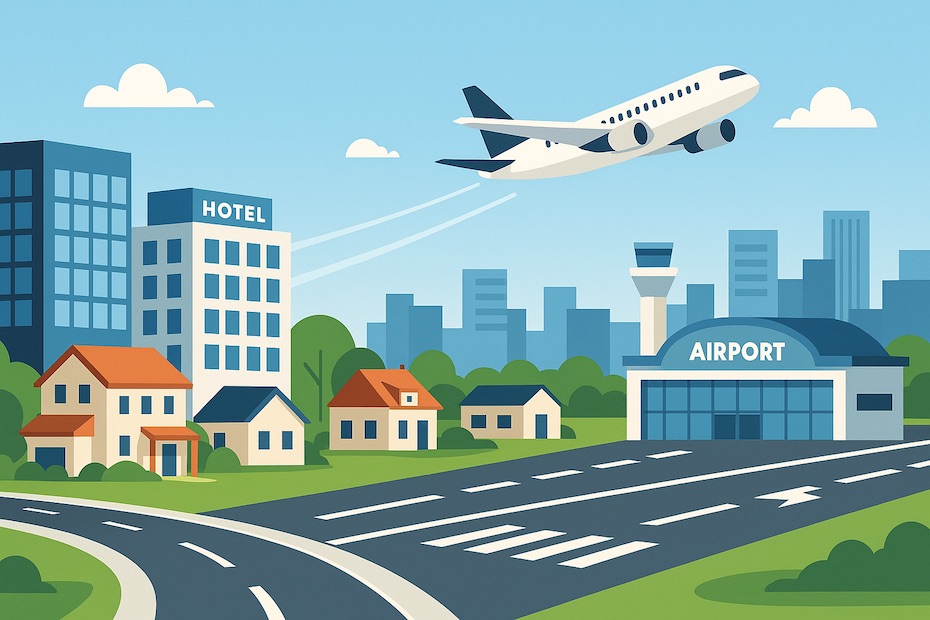
Developing real estate near regional airports offers strong connectivity, infrastructure upgrades, and rising property values, but you must navigate zoning rules, noise issues, and safety regulations.
This guide explains how to capitalize on real estate opportunities surrounding regional airports. You’ll learn what drives value, which sectors benefit most, and what challenges you must address to protect long-term returns.
What advantages do regional airports bring to nearby real estate?
Regional airports act as local economic engines. They improve connectivity, attract investment, and often trigger supporting infrastructure projects—such as road expansions, public transit routes, and utility upgrades—that make surrounding land more desirable.
These benefits extend to both commercial and residential developments. Businesses gain faster access to suppliers and customers, while residents enjoy greater travel convenience. Local governments often encourage development to support airport growth, creating favorable conditions for investors.
How do property values change around regional airports?
Airport proximity can increase property values significantly, especially for commercial and mixed-use projects. The presence of consistent traveler traffic fuels demand for hotels, restaurants, logistics hubs, and retail centers—creating strong leasing potential.
In many regions, major infrastructure upgrades tied to airport expansion have pushed land prices upward. Industrial and logistics properties near airports tend to outperform the broader market because they meet time-sensitive distribution needs. However, the uplift is most pronounced when accessibility is paired with strong zoning alignment.
Which sectors benefit most from airport-adjacent development?
Industrial and logistics tenants often prioritize proximity to airports for faster shipping and reduced transportation costs. E-commerce fulfillment centers, freight operators, and courier services are frequent occupants of airport-adjacent sites.
Hospitality and conference facilities also thrive near regional airports, capturing business travelers and hosting events that depend on quick access to air transport. Retail centers—especially those integrated with transport hubs—can benefit from both local and traveler spending.
What infrastructure improvements accompany airport development?
Airport projects often coincide with major public investment in surrounding infrastructure. Upgraded highways, expanded public transport lines, and enhanced utility capacity are common. These upgrades improve property accessibility and appeal to prospective tenants.
Local authorities may also develop business parks or special economic zones around airports to attract investment. These initiatives can create anchor tenants and cluster developments that further boost property performance.
What zoning and regulatory issues can impact development?
Zoning restrictions are one of the most common barriers. Many airports have height restrictions, land-use limitations, and noise compatibility standards that directly influence what can be built nearby.
In the U.S., FAA Part 77 regulations control airspace obstructions, while other jurisdictions have similar policies. Non-compliance can result in project delays or redesigns. Early engagement with planning authorities is essential to secure approvals and align development plans with aviation safety requirements.
How do noise and environmental factors influence planning?
Aircraft noise can deter some residential and commercial occupants. Effective soundproofing and building orientation can mitigate these impacts, but they add to development costs.
Environmental reviews may also be required to address emissions, wildlife hazards, or stormwater runoff. Sustainable design and environmental compliance not only meet regulatory demands but also improve project marketability.
How do community perceptions affect airport-adjacent projects?
Community acceptance can determine project success. While many locals value the jobs and services airports bring, others may oppose nearby development due to traffic, noise, or environmental concerns.
Transparent communication and community engagement can help build trust. Projects that include public amenities—such as green spaces or retail offerings—tend to generate more support from surrounding neighborhoods.
What real-world examples demonstrate opportunity near regional airports?
Central Coast Airport, Australia — A master plan promises hundreds of aviation-related jobs, education facilities, and environmental protections, combining economic growth with community investment.
Northwest Florida Beaches International Airport, USA — Surrounding land development plans include thousands of homes and millions of square feet of commercial space, leveraging both residential and tourism-driven demand.
Goulburn Airport, Australia — Sale offerings included operational facilities and vast expansion potential, attracting interest from investors seeking mixed-use and aviation-related opportunities.
Why develop real estate near regional airports?
- Enhanced connectivity and infrastructure investment
- Rising property values in high-demand sectors
- Strong tenant appeal for logistics, hospitality, and retail
In Conclusion
Developing real estate near regional airports offers clear upside in accessibility, infrastructure support, and value growth. Success depends on anticipating zoning limitations, environmental requirements, and community sentiment. With the right planning, these projects can deliver sustainable revenue and strengthen regional economic growth.

Chrysilios Chrysiliou is a commercial real estate executive at RDPH Properties, Inc. with a diverse background in aviation and entrepreneurship. A former Greek Air Force Academy graduate, flight instructor, and flight school co-owner, he now leverages decades of strategic leadership to identify and develop high-value real estate opportunities.