
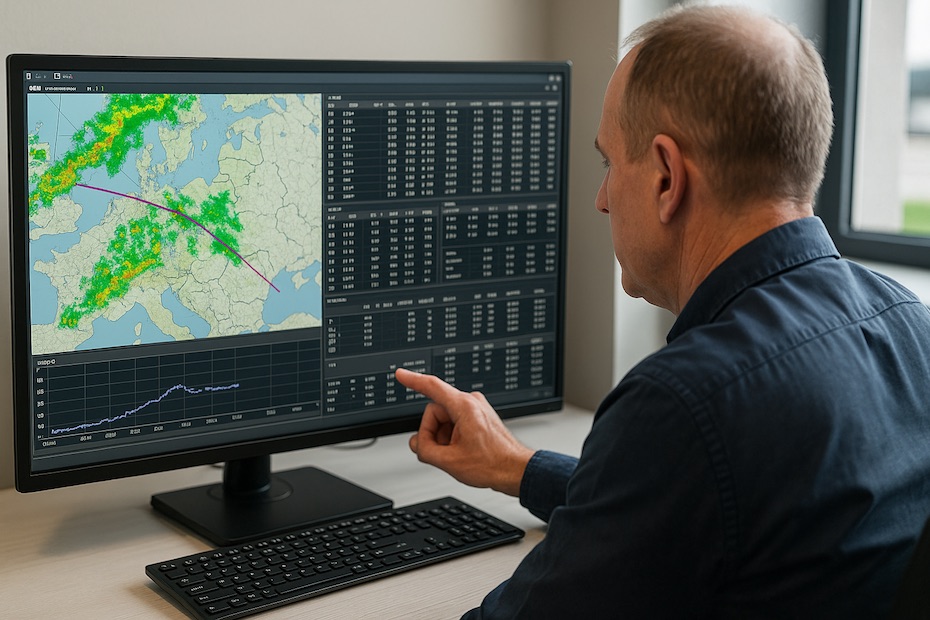
PPS Flight Planning software optimizes route efficiency by combining aircraft performance data, real-time weather modeling, and cost analysis to deliver the most economical flight paths within seconds. It helps you improve operational predictability, reduce fuel consumption, and enhance overall profitability.
You’re about to discover how PPS streamlines flight planning with precision, why it’s trusted by top aviation operators, and how it connects every stage of preflight and in-flight decision-making into a unified, data-driven workflow.
What Is PPS Flight Planning Software and Who Uses It?
PPS Flight Planning, developed by AIR SUPPORT A/S, is a comprehensive flight management solution built for commercial, business, and government aviation. It automates the complex process of route generation, fuel calculation, and compliance validation, providing dispatchers and pilots with accurate, regulation-ready flight plans in record time.
You can use PPS to handle every stage of flight preparation, from route generation to flight monitoring. It considers performance data, airspace restrictions, fuel costs, winds, and overflight fees, giving you a plan that balances speed, safety, and cost.
Its modular architecture means you only implement what fits your operation — route optimization, crew briefing, or real-time tracking — with seamless data sharing across departments. This scalability makes it the preferred solution for more than 400 operators in over 75 countries.
How PPS Flight Planning Software Optimizes Flight Routes
PPS optimizes flight routes through advanced algorithms that evaluate not just distance, but total operational cost. The system calculates real-time flight conditions using performance tables, airspace structures, and meteorological data to identify the most efficient path for every mission.
The engine behind PPS compares multiple variables simultaneously — fuel burn at different flight levels, winds aloft, temperature layers, ATC constraints, and overflight charges. Instead of focusing purely on distance, it identifies the route that saves both time and cost.
It might recommend a slightly longer path that avoids costly airspace or takes advantage of favorable winds, resulting in thousands in savings per flight. It also optimizes cruising altitudes dynamically, selecting levels that provide the ideal fuel-to-time ratio based on conditions.
How Accurate Are PPS Flight Predictions Compared to Manual or Legacy Systems?
Compared to legacy or manual systems, PPS provides a measurable improvement in forecast accuracy. Traditional methods often rely on dispatcher intuition and static models that can’t adapt to changing conditions. PPS, however, draws from certified performance databases, live weather feeds, and continuously updated airspace data.
Its predictive engine is enhanced by feedback from actual flight performance, refining estimates for fuel, time, and altitude efficiency over time. The integration with EUROCONTROL route validation ensures every filed plan is compliant before submission, reducing rerouting risks.
Operators using PPS often report a fuel burn deviation of less than 2% compared to actual results. That precision translates directly into better cost forecasting, fuel management, and operational reliability.
Modules That Drive Route Efficiency
Several modules work together to make PPS one of the most efficient systems in the industry.
Route Optimization automatically generates the most cost-effective routes by factoring in weather, NOTAMs, and airspace restrictions, then continuously refines them as conditions change.
Fuel and Performance Calculation uses exact aircraft performance tables to determine the most efficient climb, cruise, and descent profiles.
CrewBriefing delivers real-time digital flight packages — including route maps, weather, and alternate options — directly to pilots, synchronizing instantly with dispatch updates.
OpsControl and Flight Watch track flights after departure, comparing actual data with planned values to help refine future operations.
Together, these tools form a continuous feedback loop that enhances every flight with real-world operational intelligence.
Integration with Other Operational Tools
PPS integrates effortlessly with leading scheduling, dispatch, and operations systems, including Leon Software, FL3XX, and Garmin FOS. This ensures that all operational data — from maintenance status to crew assignments — stays consistent across platforms.
With EFB integration, your crews receive briefings directly on cockpit tablets, eliminating paperwork and ensuring real-time synchronization between dispatch and flight crews. PPS also provides automated flight plan filing to EUROCONTROL and FAA, further reducing administrative overhead.
By consolidating data exchange and streamlining workflows, PPS functions as the central nervous system of flight operations, connecting planning, execution, and performance tracking.
Operational Benefits You Can Measure
The real value of PPS lies in measurable efficiency gains across fuel, cost, and compliance.
Fuel Optimization: Real-time weather modeling and performance calculations minimize excess fuel loading, saving between 1% and 3% per flight — a significant reduction over a full fleet.
Reduced Airspace Fees: Cost-based route optimization helps avoid expensive airspace regions. On long-haul or polar routes, that can mean thousands in overflight savings annually.
Time Efficiency: Automated route generation and validation cut dispatcher planning time to under two minutes, allowing teams to focus on operational oversight instead of repetitive data entry.
Improved Safety and Compliance: Real-time route validation ensures compliance with ICAO, FAA, and EUROCONTROL standards, reducing rejections and in-flight adjustments.
Data-Driven Improvements: Postflight analytics identify discrepancies between planned and actual performance, enabling ongoing optimization and better cost forecasting.
Every optimization compounds over time — lower costs, higher operational reliability, and better environmental performance through reduced fuel burn.
Implementation Challenges and How to Overcome Them
Adopting PPS into an existing infrastructure requires coordination, but the transition becomes smooth when supported by structured implementation. One of the most common challenges is aligning data sources across scheduling, dispatch, and maintenance. Ensuring a single source of truth for aircraft and performance data solves this immediately.
Training is another factor. PPS’s sophistication means dispatchers need time to adjust. AIR SUPPORT’s structured training modules and side-by-side operational testing reduce this learning curve. Running PPS in parallel with your current system for a few weeks allows teams to gain confidence before full adoption.
Data freshness also matters. Assigning an internal administrator to update navigation, performance, and weather data ensures continuous accuracy — one of the defining strengths of PPS.
Within six to nine months of adoption, most operators experience measurable ROI from reduced fuel consumption, shorter dispatch times, and more accurate cost forecasting.
Why PPS Stands Out in a Competitive Market
While other systems like Jeppesen, RocketRoute, and ForeFlight Dispatch compete in the same segment, PPS distinguishes itself through its precision, flexibility, and integration depth.
Its multi-variable cost computation includes overflight, fuel, and time costs simultaneously — a level of granularity few systems replicate. PPS also works offline, allowing route generation even in areas with limited connectivity, syncing updates once a connection is restored.
The system’s open API design ensures compatibility with in-house analytics or reporting tools, making it equally viable for airlines with large fleets and private operators with custom-built data environments.
By delivering both precision and adaptability, PPS provides a balance of analytical depth and operational speed that’s unmatched among global flight planning platforms.
How does PPS optimize route efficiency?
- Evaluates total flight cost: fuel, time, and airspace fees
- Uses real-time weather and performance data
- Synchronizes planning, briefing, and tracking
- Cuts dispatcher workload and flight delays
Fly Smarter, Not Harder
Precision flight planning has become the new frontier of operational excellence, and PPS Flight Planning Software puts you at the forefront of that evolution. Its blend of automation, accuracy, and integration empowers you to reduce costs and make faster, data-backed decisions every day.

Chrysilios Chrysiliou is a commercial real estate executive at RDPH Properties, Inc. with a diverse background in aviation and entrepreneurship. A former Greek Air Force Academy graduate, flight instructor, and flight school co-owner, he now leverages decades of strategic leadership to identify and develop high-value real estate opportunities.