
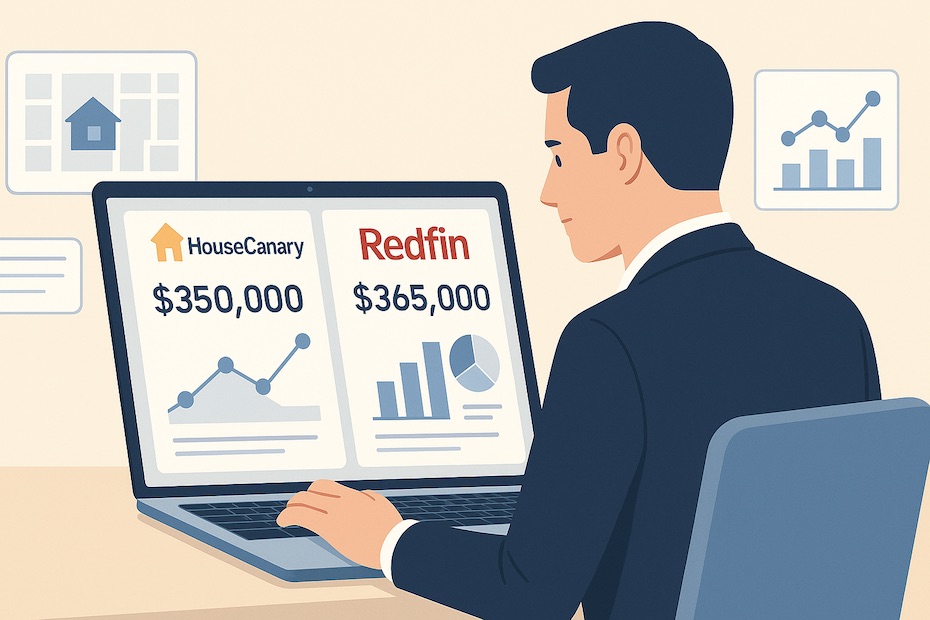
When comparing HouseCanary vs Redfin, the best AI platform for property valuations depends on what you need: Redfin offers a fast, consumer-friendly estimate, while HouseCanary provides institutional-grade analytics built for professional investors, lenders, and underwriters.
This article breaks down how both valuation platforms operate, what powers their AI models, and where each tool excels. You’ll learn how to evaluate their accuracy, how they fit into different real estate workflows, and why combining both may be the smartest move for your next investment or pricing strategy.
What Makes HouseCanary Different from Redfin in Property Valuation?
HouseCanary is a real estate data and analytics company known for producing high-accuracy automated valuation models (AVMs) that forecast property values across the U.S. It’s built for professionals—offering tools for lenders, investors, and real estate institutions that require consistent, validated pricing models.
Redfin, by contrast, is a consumer-facing real estate brokerage that provides the public with a free home valuation tool—the Redfin Estimate—powered by AI and MLS data. It’s designed to help buyers, sellers, and agents gauge listing prices quickly, though it’s not meant for underwriting or financial forecasting.
HouseCanary’s AVM draws from more than 136 million U.S. property records, applying machine learning to evaluate pricing trends, neighborhood shifts, and forecast accuracy over time. Redfin’s model relies heavily on MLS integration, recent sales, and local market activity, making it powerful for listings but less sophisticated in long-term forecasting.
In essence: HouseCanary focuses on predictive accuracy and institutional reliability, while Redfin focuses on accessibility and user convenience.
How Accurate Are the Valuation Models from Each Platform?
Accuracy is where these two AI platforms diverge most clearly.
HouseCanary reports a median absolute percentage error (MAPE) near 3.1%, which places it among the most precise AVMs in the U.S. market. It continuously validates results with both internal and third-party testing, which is critical for lenders who need models that meet regulatory standards. The company’s predictive forecasts can project property value changes up to three years out.
Redfin claims a median error rate of 1.95% for on-market homes, which means that half of its estimates fall within roughly two percent of the actual sale price. For off-market homes, however, the accuracy drops significantly, averaging around 7.5%. This happens because off-market valuations rely on older, less complete data.
If you’re working with properties actively listed or recently sold, Redfin’s estimate can serve as a quick, near-real-time benchmark. But if you need future forecasting, risk analysis, or asset-based underwriting, HouseCanary’s more structured, model-driven system delivers superior consistency and defensibility.
What Data Sources Power HouseCanary and Redfin’s AI Algorithms?
Both platforms draw from massive datasets—but the quality and diversity of their data define their performance.
HouseCanary’s valuation model combines public records, MLS data, appraisal data, economic indicators, and geospatial layers. This allows it to account for factors like school zones, migration trends, and localized housing economics. The system updates regularly, refining its predictions with every new transaction, remodel, or demographic shift detected.
Redfin, leveraging its position as a national brokerage, benefits from direct MLS integration in many markets. This gives it real-time visibility into price changes, days on market, and listing status updates. However, Redfin doesn’t typically ingest as much macroeconomic or predictive data, which limits its forecasting depth.
HouseCanary also integrates machine learning models that detect outliers, helping identify when an outlier sale (like a distressed property) could skew averages. Redfin’s model is simpler—it uses comparable property logic weighted by recency and similarity.
If your work involves real estate analytics or portfolio management, you’ll find HouseCanary’s dataset far more actionable. If you’re pricing a single property for sale, Redfin provides a convenient, free data layer.
Which Platform Performs Better for Real Estate Investors?
If your objective is long-term investment performance, HouseCanary outpaces Redfin. Its tools are purpose-built for decision-makers managing multiple assets or assessing deal pipelines.
Through HouseCanary’s Agile Insights and Home Price Index (HPI) forecasting, you can:
- Evaluate property performance across time horizons.
- Estimate cap rate potential using regional growth data.
- Model pricing volatility across metros or ZIP codes.
- Access API integrations for internal portfolio analytics.
Redfin, while excellent for identifying comps or current neighborhood pricing, lacks that predictive capability. It doesn’t provide forecasting analytics or stress-test models—two key functions investors use to hedge risk.
Institutional players, private equity firms, and banks often embed HouseCanary’s valuation data into their underwriting pipelines, ensuring every deal aligns with macroeconomic forecasts. Redfin is useful at the consumer layer, not the enterprise level.
How Should You Use Redfin as a Professional?
Even as an expert, Redfin’s platform can still be valuable. You can use it to benchmark market sentiment or cross-check pricing visibility from a public perspective. Because millions of users rely on Redfin’s home estimates daily, it helps you gauge how the general market perceives a property’s value.
If you’re advising clients, Redfin’s numbers give you a conversation starting point. You can show clients what buyers see online, then layer your professional valuation or HouseCanary’s forecast to demonstrate a more accurate range.
Redfin’s free accessibility also makes it ideal for quick checks during negotiations. Within seconds, you can confirm recent comps, active listings, and price changes—valuable for agents or brokers managing multiple deals.
But keep in mind: Redfin is not a valuation authority. It’s a reference, not a replacement for a certified appraisal or model-grade forecast.
What Are the Limitations of AI Valuations from Both Platforms?
Automated valuation models, regardless of sophistication, face shared limitations that you must navigate carefully.
1. Interior condition and improvements: Neither Redfin nor HouseCanary directly captures property condition unless the updates are reported in MLS listings or building permits. A renovated kitchen or upgraded HVAC system may not register, leading to undervaluation.
2. Market anomalies: Local events—such as sudden employer relocation, infrastructure development, or natural disasters—can distort valuations before models adjust.
3. Data latency: Property records can lag weeks behind actual transactions, creating short-term inaccuracy during volatile periods.
4. Model drift: Over time, predictive algorithms may overfit or underreact to changing data distributions if not retrained frequently.
5. Human overconfidence: The greatest risk is assuming AI valuations are absolute truths. Both systems perform best as decision aids, not final arbiters.
By layering multiple data sources—including appraisals, comps, and direct inspections—you offset these blind spots and strengthen your valuation accuracy.
Which Platform Is Better for Everyday Real Estate Professionals?
If you’re an agent or advisor focused on listing strategy and client communication, Redfin’s transparency and interface give it an edge for everyday use. It’s intuitive, widely recognized, and free.
For brokers, underwriters, or institutional asset managers, HouseCanary remains unmatched. Its forecasting models, batch processing, and API-level integration make it a strategic tool that scales across portfolios and national markets.
Think of it this way:
- Redfin helps you explain price.
- HouseCanary helps you defend value.
In a client-facing scenario, you might show Redfin’s estimate as public data, then present your professional analysis from HouseCanary’s forecast to back your recommendation. This dual-pronged approach positions you as both transparent and data-driven.
How to Combine HouseCanary and Redfin for Smarter Decisions
Rather than choosing one, the best practice is to combine both platforms to strengthen your valuation process.
You can start by checking Redfin’s free valuation to see where consumer perception stands, then overlay HouseCanary’s professional forecast for institutional precision. Here’s how that looks in practice:
- Use Redfin to benchmark on-market comps and gauge public perception.
- Use HouseCanary to assess underlying market trends and long-term projections.
- Monitor variance between models (e.g., >5% difference) as a red flag for deeper investigation.
- Feed both into your CMA or underwriting models to refine your risk-adjusted pricing.
- Integrate HouseCanary’s API if you manage multiple assets and need daily valuation updates.
This layered approach ensures your valuations align with both market visibility and professional-grade precision.
HouseCanary vs Redfin AI Valuation
- HouseCanary: Institutional-grade, predictive, accurate (3.1% MAPE)
- Redfin: Consumer-accessible, MLS-based, fast (1.9% on-market error)
- Use both: Redfin for visibility, HouseCanary for validated insight
Data Intelligence Is the Future of Real Estate
AI valuation platforms are no longer optional—they’re reshaping how real estate professionals make pricing decisions, manage portfolios, and forecast market risk. HouseCanary and Redfin each serve a distinct role: one for precision and performance, the other for speed and transparency. Using both together gives you an unmatched advantage in accuracy, credibility, and client confidence.

Chrysilios Chrysiliou is a commercial real estate executive at RDPH Properties, Inc. with a diverse background in aviation and entrepreneurship. A former Greek Air Force Academy graduate, flight instructor, and flight school co-owner, he now leverages decades of strategic leadership to identify and develop high-value real estate opportunities.